
 , Samaneh Ghorbani Shirkouhi 2,†, Poul Flemming Høilund-Carlsen 3,4, Mona-Elisabeth Revheim 5,6, Abass Alavi 7, Morten Blaabjerg 8,9, Sasan Andalib 8,9,*
1 Department of Neurology, University of California Irvine, Irvine, CA 92617, USA
2 Student Research Committee, School of Medicine, Shahroud University of Medical Sciences, 3614773943 Shahroud, Iran
3 Department of Nuclear Medicine, Odense University Hospital, University of Southern Denmark, 5000 Odense, Denmark
4 Department of Clinical Research, Faculty of Health Sciences, University of Southern Denmark, 5230 Odense, Denmark
5 The Intervention Center, Division of Technology and Innovation, Oslo University Hospital, 0450 Oslo, Norway
6 Institute of Clinical Medicine, University of Oslo, 0313 Oslo, Norway
7 Department of Radiology, Perelman School of Medicine, University of Pennsylvania, Philadelphia, PA 19104, USA
8 Research Unit of Neurology, Department of Clinical Research, Faculty of Health Sciences, University of Southern Denmark, 5230 Odense, Denmark
9 Department of Neurology, Odense University Hospital, 5000 Odense, Denmark
†Co-first authors contributed equally.
Abstract
While vaccination against severe acute respiratory syndrome coronavirus 2 (SARS-CoV-2) remains crucial, neurological complications have been detected following the coronavirus disease 2019 (COVID-19) vaccination. The neurological complications of COVID-19 vaccination can be seen in both the central nervous system (CNS) and the peripheral nervous system (PNS). In this study, we reviewed PNS complications after COVID-19 vaccination, their underlying mechanisms, diagnosis, and management. Inflammatory polyneuropathy, small fiber neuropathy, Parsonage-Turner syndrome (PTS), cranial mononeuropathies, and myasthenia gravis (MG) have been reported following COVID-19 vaccination. Inflammatory polyneuropathy following COVID-19 vaccination should be diagnosed early based on clinical presentation and treated with supportive care, and immunoglobulin or plasmapheresis to prevent respiratory distress if required. It is important to differentiate peripheral from central facial paralysis after COVID-19 vaccination to rule out upper motor neuron damage, including stroke. Diagnosis of small fiber neuropathy in the setting of COVID-19 vaccination should be suspected in patients with dysesthesia, dysautonomia, and lower extremity paresthesia. A skin biopsy of the proximal or distal lower limb should generally be considered for diagnosing small fiber neuropathy following COVID-19 vaccination. Even though pain at the injection site is one of the most common symptoms after COVID-19 vaccination, shoulder pain lasting more than 3 weeks should raise the suspicion of severe complications such as PTS. In addition to a proper physical examination as a reliable diagnosis tool, needle electromyography can be considered to help the diagnosis of PTS following COVID-19 vaccination. In our opinion, despite complications after COVID-19 vaccination, the benefit of vaccination immunity should not be forgotten.
Keywords
- neurological complications
- peripheral nervous system
- COVID-19
- SARS-CoV-2
- vaccination
- vaccine safety
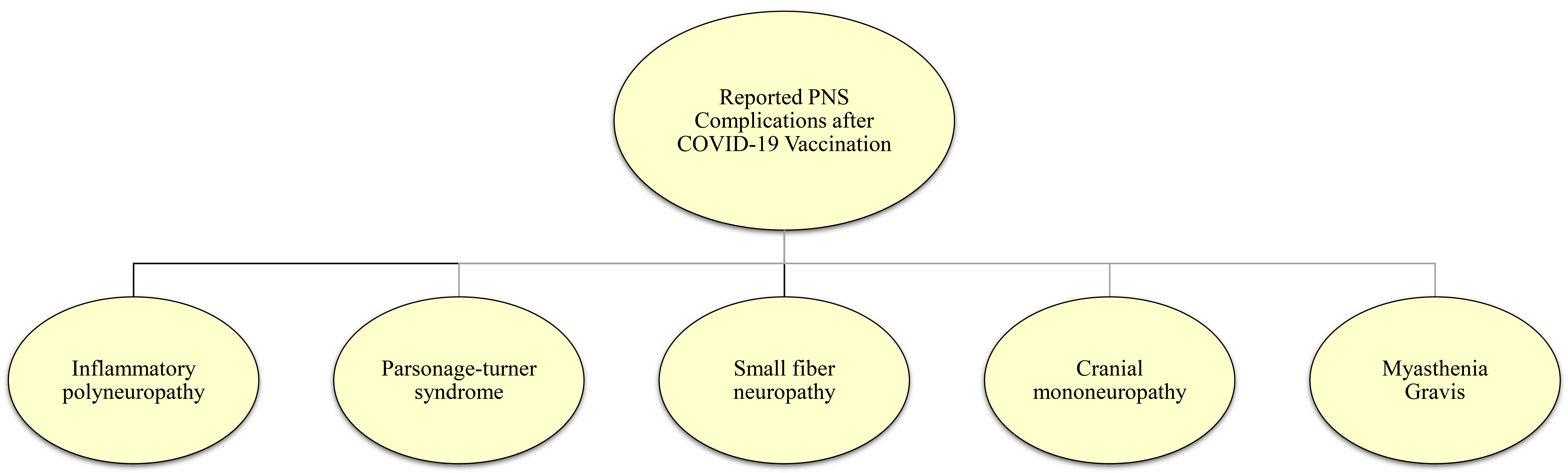
The novel severe acute respiratory syndrome coronavirus 2 (SARS-CoV-2) caused coronavirus disease of 2019 (COVID-19) and spread widely around the world [1]. SARS-CoV-2 is a positive-sense, enveloped, single-stranded ribonucleic acid (RNA) virus belonging to the Betacoronavirus family [2] that can enter host cells via binding of the spike (S) protein to angiotensin-converting enzyme 2 (ACE2) receptor following membrane fusion [3]. Preventing and controlling COVID-19 is most effectively accomplished through vaccination [4]. There are two most well-known mRNA vaccines, BNT162b2 (Pfizer) and mRNA-1273 (Moderna) [5]. COVID-19 vaccines demonstrated significant protection and adequate antibody levels against different variants of SARS-CoV-2 viruses, such as Omicron [6]. There have been numerous reports of neurological side effects following COVID-19 vaccination. Fig. 1 lists the reported peripheral nervous system (PNS) complications after COVID-19 vaccination.
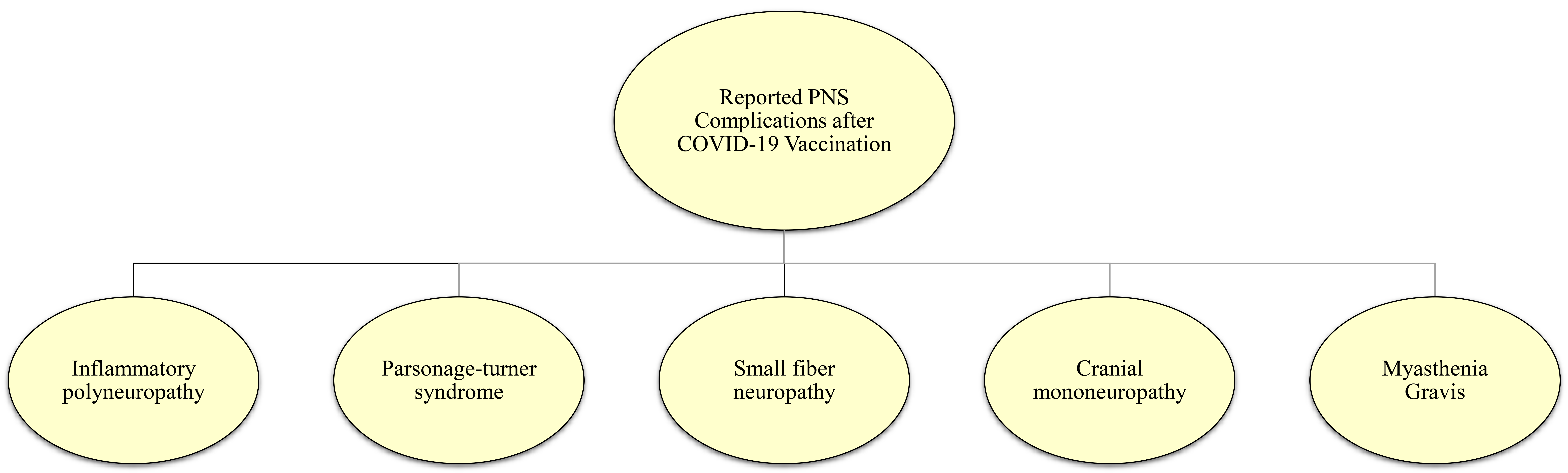 Fig. 1.
Reported peripheral nervous system (PNS) complications after coronavirus disease 2019 (COVID-19) vaccination.
This present review summarizes the PNS complications after COVID-19 vaccination, their underlying mechanisms, diagnosis, and management. A summary of studies reporting PNS complications after COVID-19 vaccination is shown in the Supplementary Material.
The range of inflammatory polyneuropathies includes Guillain-Barré syndrome
(GBS), which has an acute onset, and chronic inflammatory demyelinating
polyneuropathy (CIDP), which progresses slowly over time or has a relapsing
course [7]. GBS symptoms include the loss of deep tendon reflexes, muscle
weakness [8], and a higher protein concentration in the cerebrospinal fluid (CSF)
while maintaining a normal cell count [9]. The empirical or epidemiological
evidence has not substantiated the link between GBS and COVID-19 vaccines [10].
In a meta-analysis, the prevalence of GBS was reported to be 8.1 per 1,000,000
COVID-19 vaccinations [11]. In this study, a total of 138 patients, with a mean
age of 56.8
Le Vu et al. [36] using the French national health data system linked to the COVID-19 vaccine database analyzed all individuals aged 12 years or older admitted for GBS from December 27, 2020, to May 20, 2022. They stated that of 58,530,770 people aged 12 years or older, 88.8% received at least one COVID-19 vaccine dose and 2229 were hospitalized for GBS during the study period. They also estimated 6.5 GBS cases per million persons and 5.7 cases per million who have received the first dose of Oxford-AstraZeneca and Ad26.COV2.S (Johnson & Johnson/Janssen) vaccine, respectively.
Some case reports have indicated that treatment with IVIG and corticosteroids has improved the signs and symptoms of inflammatory polyneuropathies following COVID-19 vaccination [16, 19, 37]. In the case series study by Min et al. [24], both cases received only supportive care. In the case series by de Souza et al. [34], one out of four patients showed symptom relief after plasma exchange, a treatment that has also shown improvement in other case reports [26, 38, 39].
Parsonage-Turner Syndrome (PTS), or idiopathic brachial plexus neuropathy, usually known as neuralgic amyotrophy, is characterized by new-onset pain in the shoulder or upper arm without responding to over-the-counter analgesics [40, 41]. Patients with PTS show paresis and tingling for hours or days, as the brachial plexus nerves, including the long thoracic, suprascapular, and especially those on the lateral side of the upper limb, are involved, along with nerves outside of the brachial plexus in some cases [41]. In general, men are more likely to develop PTS than women [40], typically with a mean age of 41.3 years for idiopathic forms [41]. Physical examination is the most reliable way to diagnose PTS [42]. Physicians should consider the following criteria when making a diagnosis: a new onset of shoulder pain, a pain score above 7 (range 0–10, with 10 indicating worst pain), abnormal movement of the shoulder during maximum abduction or anteflexion, and symptoms manifested more than 3 weeks after onset [43]. PTS can be excluded if one or more of these items are detected during the examination: diabetes mellitus, Horner syndrome, symmetric weakness, or pain that persists for more than three months, with only passive range-of-motion restrictions in the glenohumeral joint [43]. In contrast to nerve conduction velocity studies, needle EMG is sensitive to detecting denervation only after confirmation by physical examination [44].
The exact mechanism of PTS is not well-understood; however, the immune-mediated mechanism is considered one of the relevant causes due to molecular mimicry and autoimmune responses following COVID-19 vaccination [45]. Several case reports noted PTS following COVID-19 vaccination with Pfizer [46, 47, 48, 49, 50, 51, 52, 53, 54, 55], Moderna [46, 47, 48, 56, 57], and Oxford-AstraZeneca vaccines [48, 58, 59, 60, 61]. Some case reports highlighted pain and weakness contralateral to the COVID-19 vaccine injection site [47, 51, 52, 61]. Corticosteroid treatment was used as a primary treatment in several reports of PTS after COVID-19 vaccination [52, 54, 56, 57, 61]. Non-steroidal anti-inflammatory drugs (NSAIDs) [59, 62], Pregabalin [59], physical therapy [46, 47, 49, 59], and occupational therapy [50] were other types of treatment in the setting of PTS following COVID-19 vaccination. In one study, a fentanyl patch was also used as a treatment for PTS after COVID-19 vaccination [48], and in another study, no treatment was reported [52]. Queler et al. [46] reported a case of PTS occurring 13 hours after the administration of the COVID-19 vaccine, in a patient with a history of Lyme disease two months prior to receiving the vaccine injection. A high number of ipsilateral lymphadenopathies (87.5%) in the setting of PTS following COVID-19 vaccination were noted in the study by Min et al. [48]. In addition, a previous study reported the occurrence of lymphadenopathy in patients with breast cancer after vaccination with the Moderna vaccine [63]. However, none of the lymphadenopathic cases were reported to have cancer in the study of Min et al. [48]. Crespo Burillo et al. [58] reported a 38-year-old case of diaphragm paralysis associated with PTS following COVID-19 vaccination. He presented with PTS symptoms four days after receiving the Oxford-AstraZeneca vaccine. An MRI of the shoulder revealed mild left subacromial tendinopathy, while a cervical MRI appeared normal. EMG evaluation later confirmed that all three trunks of the left brachial plexus were involved. The patient received intravenous methylprednisolone (IVMP) followed by oral prednisone and his symptoms resolved after two weeks. However, 40 days post-vaccination, he developed severe dyspnea. A chest computed tomography (CT) scan revealed left diaphragm paralysis and mild left basilar atelectasis. He was then treated with nocturnal continuous positive airway pressure. Min et al. [48] reported cases of PTS following COVID-19 vaccination, in which three cases had elevated protein levels in their CSF. The first patient, a 31-year-old male, exhibited PTS symptoms six days after receiving the Johnson & Johnson COVID-19 vaccine. His CSF protein level was 70 mg/dL, with no WBCs detected. He recovered completely without any treatments. The second patient, a 71-year-old male, developed PTS symptoms 16 days post-vaccination with the first dose of the Oxford-AstraZeneca vaccine. His CSF analysis showed 2 WBCs and a protein level of 57 mg/dL. He experienced a poor recovery after 15 weeks, despite receiving a combination therapy of oral prednisolone and gabapentin. The third patient, a 39-year-old male, reported PTS symptoms seven days after the first dose of Moderna vaccination. His CSF contained one WBC and a protein level of 76 mg/dL. His recovery was limited, even after eight weeks of treatment with IVMP, oral prednisolone, and gabapentin.
In a study by Shields et al. [47], four out of six cases received corticosteroids and demonstrated symptom relief. Additionally, patients in several other case reports [53, 58] who were treated with high-dose prednisone showed symptom improvement in PTS following COVID-19 vaccination. In a case series study by Queler et al. [46], only one of the two cases received high-dose prednisone and showed improvement. Additionally, in this case series, only one of the two cases received non-steroidal anti-inflammatory drug (NSAID) therapy and showed symptom improvement, while the other patients did not receive this treatment. Similarly, in a case report by Vitturi et al. [59], symptom improvement was observed after NSAID therapy. In general, because the immune response is believed to be responsible for PTS following vaccination, IVIG is considered an alternative treatment; however, it has not been proven effective [64].
In small fiber neuropathy, which is a type of peripheral neuropathy, the axons of small unmyelinated (C) or poorly myelinated (Ad) fibers are selectively damaged [65]. Small fiber neuropathy was reported following the administration of Oxford-AstraZeneca [66], Moderna [67], and Pfizer COVID-19 vaccines [68, 69, 70]. Dysesthesias [66], dysautonomia, and paresthesia [68] were shown to be the primary symptoms in the cases with small fiber neuropathy following COVID-19 vaccination. Positive antinuclear antibody (ANA) titers and antineutrophil cytoplasmic antibodies were reported in one case study of small fiber neuropathy after COVID-19 vaccination [66]. Abbott et al. [66] reported cases of small fiber neuropathy after COVID-19 vaccination, with potential immune markers identified in their laboratory results. In one case, a 69-year-old female presented with dysesthesias, altered temperature sensations in her upper and lower extremities, and a mild reduction in vibration sensation at the right toe seven days after receiving the first dose of the Oxford-AstraZeneca vaccine. She had a past history of a spinal cord syrinx in the lumbar spine, confirmed by lumbar MRI. Small fiber neuropathy was confirmed through a skin biopsy, which indicated decreased epidermal nerve fiber density. Interestingly, ANA test was positive, and immunoglobulin A levels were elevated in her blood studies. Additionally, another case in this study involved a 55-year-old female who experienced bilateral burning pain, dysesthesias, altered temperature sensations in her upper and lower extremities, and numbness and paresthesia in her cheeks, nose, and tongue ten days after the first dose of the Oxford-AstraZeneca vaccine. Cervical MRI detected dilatation of the central canal of the cervical spinal cord, with no evidence of a syrinx. Small fiber neuropathy was again confirmed by a skin biopsy showing decreased intraepidermal nerve fiber density. According to her blood tests, both anti-neutrophil cytoplasmic antibody and ANA were positive. A skin biopsy of the proximal or distal lower limb demonstrating reduced epidermal nerve fiber density has high efficacy in diagnosing small fiber neuropathy in general [65], which has been observed by several case reports of small fiber neuropathy after COVID-19 vaccination [66, 67, 68, 69, 70]. In multiple case reports, unremarkable EMG and nerve conduction were noted in studies of small fiber neuropathy following COVID-19 vaccination [70, 71]. Treatment with IVIG [68, 69] and plasma exchange [69] have been reported. The majority of the above cases were recovered, however, in one case [66], symptoms became more intense after the second dose of COVID-19 vaccination, and the condition of two patients remained unchanged [66, 67].
Case reports have shown that IVIG therapy [68, 71] and plasma exchange [69] can improve the symptoms of small fiber neuropathy following COVID-19 vaccination.
Deshmukh et al. [72] reported a case of a 13-year-old male patient who presented with primary symptoms of headache, diplopia, giddiness, and drooping of the left eye, occurring one hour after receiving the second dose of the BECOV2D (Corbevax) COVID-19 vaccine. Following a diagnosis of third nerve palsy, the patient was treated with IVMP and lubricant eye drops. His symptoms improved after four days. In another case report, Cicalese et al. [73] described an 88-year-old man who developed diplopia, dizziness, right eye abduction with downward deviation, and gait instability three days after receiving the first dose of the Moderna vaccine. The patient was diagnosed with incomplete palsy of the right third cranial nerve. After two weeks of oral steroid treatment, his symptoms improved. Moreover, Liu et al. [74] reported a case of a 70-year-old woman who developed progressive unilateral oculomotor nerve palsy and decreased visual acuity due to optic nerve dysfunction, 12 days following the injection of the first dose of Moderna vaccine. After steroid therapy proved ineffective, her symptoms responded well to plasma exchange.
Ginés-Gallego et al. [75] described a 76-year-old woman who developed binocular vertical diplopia, right eye exotropia, and a mild adduction deficit in the right eye 15 days after receiving her second dose of the Pfizer vaccine. A provisional diagnosis of right fourth cranial nerve palsy was made, and her symptoms spontaneously resolved within ten days.
Chrostowski et al. [76] highlighted the case of a 36-year-old woman who was hospitalized due to persistent pain on the left side of her face. The pain had begun two months earlier, following the administration of her third dose of the Pfizer vaccine. The patient described the pain as paroxysmal attacks lasting 4–5 seconds each, triggered by mouth and jaw movements, and localized to the regions innervated by the second and third branches of the left trigeminal nerve. Initial treatment with carbamazepine and lignocainum hydrochloridum provided no relief. Consequently, a combination of oxcarbazepine, dexamethasone, and pregabalin was initiated, resulting in gradual improvement. The symptoms completely resolved six months after the onset of the condition.
Ginés-Gallego et al. [75] reported a 75-year-old woman who developed binocular horizontal diplopia and a pronounced abduction deficit in her left eye, occurring 15 days after the second dose of Pfizer vaccine. The diagnosis confirmed left abducens nerve paralysis. Following a lack of symptomatic improvement over two weeks, she underwent an injection of botulinum toxin A into the left medial rectus muscle, which subsequently led to a marked resolution of symptoms within the next week. In another study, Albattah et al. [77] reported a case of bilateral sequential abducens nerve palsy in a 42-year-old woman, occurring two days after she received her first dose of the Pfizer vaccine. Her symptoms gradually improved over two months with conservative therapy.
Bell’s palsy causes acute paresis or paralysis of the peripheral facial nerve. However, the actual mechanism of Bell’s palsy is not well-understood [78]. A meta-analysis comprising 105 patients found that Bell’s palsy after COVID-19 vaccination was more common in men aged 30–60 years [79]. According to this meta-analysis, Pfizer was the most commonly used vaccine, and the average time after vaccination to onset of symptoms was 11.6 days. In addition, the rate ratio of Bell’s palsy was also 25.3 per 1,000,000 and more common after the first dose and after vaccination with Oxford-AstraZeneca. Mason et al. [80] described a case with right hemifacial palsy as an initial symptom that progressed to bilateral facial palsy four weeks after COVID-19 vaccination. Burrows et al. [81] reported a case of facial palsy following both the first and second doses, with right hemifacial palsy after the first dose, and left hemifacial palsy after the second dose of COVID-19 vaccination. Martin-Villares et al. [82] reported a case of right-sided facial palsy following the administration of the first dose of the Moderna vaccine in a 34-year-old woman with a history of facial palsy during her pregnancy in 2012. Two case reports highlighted upper limb paralysis on the same side as facial paralysis after COVID-19 vaccination [80, 83]. Shemer et al. [84] reported a case of left hemifacial paralysis following the Pfizer vaccine, accompanied by a periauricular vesicular rash and bilateral sensorineural hearing loss. Despite some reports of Bell’s palsy after vaccination with Pfizer, no significant relationship has been demonstrated between this vaccine and the risk of facial nerve palsy [85, 86, 87]. Renoud et al. [88] reported that there is no association between Pfizer vaccine and Bells’ palsy using a disproportionality analysis. Nonetheless, Wan et al. [89] reported a high incidence rate of Bell’s palsy following Sinovac (CoronaVac) vaccination. The definitive proof of COVID-19 vaccine-induced Bell’s palsy has not been confirmed yet, and since Bell’s palsy is self-limited, the value of vaccination surpasses any potential danger [90].
What should be noted in Bell’s palsy after the COVID-19 vaccination is the distinction between peripheral and central facial paralysis. In general, patients with central facial paralysis can wrinkle their forehead on the affected side, a sign of severe disease related to upper motor neurons including stroke [91], while patients with peripheral facial palsy are unable to wrinkle their forehead due to extratemporal facial nerve damage [92].
To minimize chronic sequelae by Bell’s Palsy after COVID-19 vaccination, it is crucial to diagnose the condition as early as possible. Several reports of Bell’s palsy following COVID-19 vaccination have demonstrated the effectiveness of promptly initiating corticosteroid treatment, along with supportive care measures such as facial muscle training, the use of eye-protecting ointment, and overnight application of an eye patch [81, 83, 93, 94].
Okayasu et al. [95] reported the case of a 34-year-old man who experienced dysphasia, tingling on the right side of his tongue, and difficulty speaking, beginning three days after receiving the third dose of the COVID-19 vaccine (type of vaccine not stated). The initial diagnosis was right hypoglossal nerve palsy, but his condition progressed to include weakness in the right upper and lower extremities. Mononeuritis multiplex was eventually confirmed, and he was treated with oral prednisolone, IVMP, and IVIG. However, due to side effects and the extension of tingling to his right scalp, IVMP, and IVIG were discontinued, and valacyclovir was added to his treatment regimen alongside prednisolone. His symptoms gradually improved with rehabilitation.
Several case reports [72, 74, 81, 95, 96, 97] noted symptom improvement in patients with cranial mononeuropathies following COVID-19 vaccination after being treated with corticosteroids. Plasma exchange has been reported in a case report study to improve cranial mononeuropathies’ symptoms following COVID-19 vaccination [74].
Chavez and Pougnier [98] reported a case of late-onset myasthenia gravis (MG) newly diagnosed in an 82-year-old male who developed intermittent episodes of slurred speech, difficulty chewing, and trouble spitting following Pfizer vaccination. Notably, acetylcholine receptor antibodies were detected, and the MG diagnosis was confirmed with EMG. Thymoma, however, was ruled out. Despite treatment with intravenous pyridostigmine, IVIG, and steroids, his symptoms worsened, necessitating intubation and the placement of a percutaneous endoscopic gastrostomy (PEG) tube. Eventually, his condition improved, and he was discharged to a rehabilitation facility for further care. In the study by Alcantara et al. [99], among 3461 patients with MG who received the first dose of the COVID-19 vaccine, fewer than six individuals were hospitalized due to an MG flare within 30 days. In addition, MG patients who were vaccinated had a significantly lower risk of COVID-19 infection compared to unvaccinated MG patients (hazard ratio, 0.43; 95% confidence interval (95% CI), 0.30–0.60). Furthermore, in a case series study involving 22 patients with MG who received the COVID-19 vaccine, only two individuals experienced a mild worsening of their symptoms, which resolved shortly thereafter [100]. This emphasizes that the benefits of COVID-19 vaccination outweigh the risks of a flare in MG patients. Other case reports have also reported MG in patients with a past history of MG after receiving the Pfizer [101], Moderna [102], and Oxford-AstraZeneca [103] vaccines. To minimize the risk of a vaccine-induced flare in MG, it is recommended that patients with MG receive the COVID-19 vaccine when their symptoms are minimal, nonexistent, or during an inactive phase of the disease [104].
In several case reports, IVIG therapy [98, 105, 106] and corticosteroids therapy [105, 107] improved MG symptoms after COVID-19 vaccination.
This paper is a narrative review and, as such, is susceptible to selection and reporting biases. A systematic review and meta-analysis were not conducted, so the conclusions drawn regarding each manifestation are based on interpretations of the existing literature. Previously, PNS complications following COVID-19 vaccination have been addressed in some review articles. The primary aim is to present the current literature and highlight potential research gaps, though this approach may occasionally lack neutrality. In narrative reviews, it is common for authors to express their perspectives or favor certain viewpoints. Additionally, the Supplementary Material was designed to support our literature base, but some articles may be missing from the table, which is acceptable within the scope of a narrative review. Moreover, any treatment or management noted in this narrative review for each specific PNS manifestation is based solely on the recommendations mentioned in the cited articles and papers and does not represent the authors’ opinions or recommendations. Several of the references cited in this review are case reports and case studies and therefore the symptoms and complications after the vaccination could be coincidental. While these studies are useful for initial observations, they are less reliable for establishing causality. Furthermore, different vaccines may have various complications. It cannot be concluded that a complication is a vaccine side effect or it is a reactivation of an underlying disease. Therefore, the conclusions presented in this paper should be interpreted with caution.
COVID-19 vaccination has been reported to have a coincidental temporal association with PNS complications including inflammatory polyneuropathy, small fiber neuropathy, MG, cranial mononeuropathies, and PTS. However, in our view, despite these side effects the improved immunity obtained with COVID-19 vaccination should not be forgotten. Nonetheless, to be able to intervene and limit the consequences of vaccine-related PNS, healthcare providers need to recognize them at an early stage by their initial signs and symptoms, which include paresthesia and paresis in the upper and lower limbs, areflexia, hyporeflexia, facial paralysis, dysesthesias, dysautonomia, pain, and weakness. Only in this way can severe disease and long-term disability be prevented.
ACE2, angiotensin-converting enzyme 2; ANA, antinuclear antibody; CI, confidence interval; CIDP, chronic inflammatory demyelinating polyneuropathy; COVID-19, coronavirus disease 2019; CSF, cerebrospinal fluid; CT, computed tomography; EMG, electromyography; GBS, Guillain-Barré syndrome; GM1, Ganglioside-monosialic acid; IVIG, intravenous immunoglobulin; IVMP, intravenous methylprednisolone; MG, myasthenia gravis; MRI, magnetic resonance imaging; NSAIDs, non-steroidal anti-inflammatory drugs; PEG, percutaneous endoscopic gastrostomy; PNS, peripheral nervous system; PTS, Parsonage-Turner syndrome; RNA, ribonucleic acid; SARS-CoV-2, severe acute respiratory syndrome coronavirus 2; WBC, white blood cell.
SSK and SGS designed the figure. SA conceptualized the study. SSK, SGS, PFHC, MER, AA, MB, and SA contributed to literature research. All authors contributed to editorial changes in the manuscript. All authors read and approved the final manuscript. All authors have participated sufficiently in the work and agreed to be accountable for all aspects of the work.
Not applicable.
Not applicable.
This research received no external funding.
The authors declare no conflict of interest.
Supplementary material associated with this article can be found, in the online version, at https://doi.org/10.31083/JIN26632.
References
Publisher’s Note: IMR Press stays neutral with regard to jurisdictional claims in published maps and institutional affiliations.